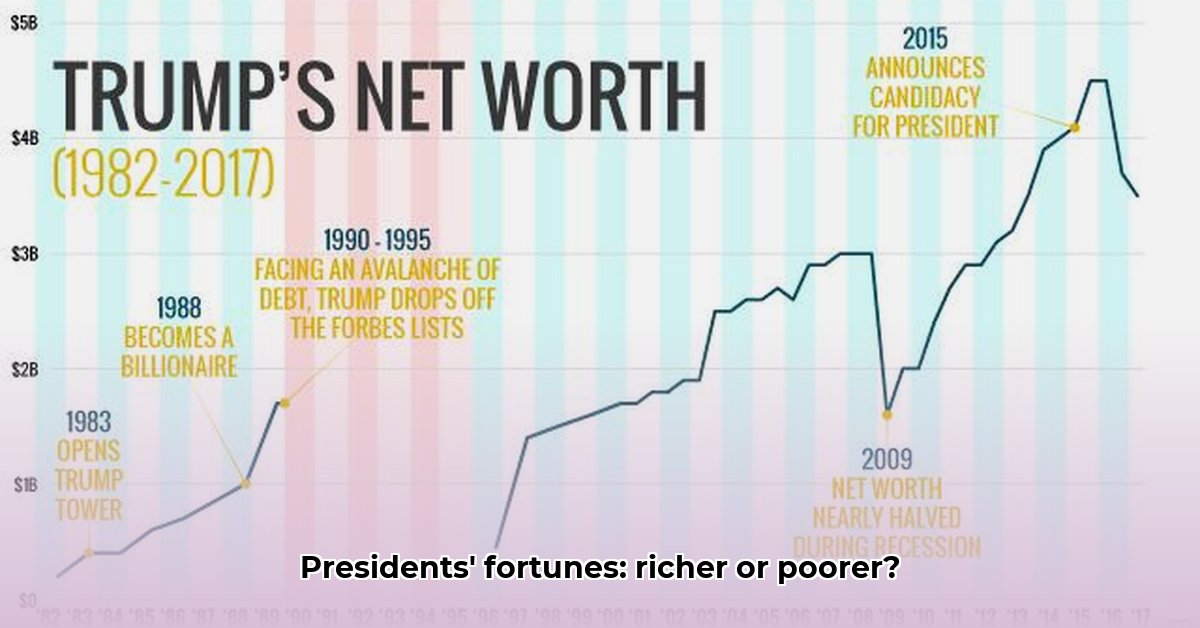
Presidential Net Worth: The Elusive Truth
Determining the net worth of a U.S. president is surprisingly complex. Unlike simply looking up a number online, calculating presidential wealth requires navigating a multifaceted landscape of assets, liabilities, and inherent limitations in available data. This informational article explores the challenges in accurately assessing presidential finances, both during and after their time in office, and suggests avenues for improved transparency and future research. For further data on wealth changes, see this helpful resource on household net worth changes.
The Challenges of Assessing Presidential Wealth
The difficulty in precisely calculating a president's net worth stems from several factors. Firstly, readily available data is often incomplete or inconsistent. Public financial disclosures offer a glimpse into assets and liabilities, but these often lack the detail needed for a precise assessment. Many assets, such as real estate holdings or privately held businesses, are difficult to value accurately. Appraisals can vary widely, leading to significant discrepancies in reported net worth figures. This inherent variability makes direct comparisons between presidents problematic. Secondly, a significant portion of a president's wealth may be held in complex trusts, undisclosed investments, or potentially even overseas holdings, making a comprehensive assessment impossible without full transparency. Finally, different methodologies for evaluating assets further complicate accurate calculation making direct comparisons between administrations difficult.
Presidential Finances: Before, During, and After the White House
While some presidents enter the White House with substantial wealth, others have more modest financial beginnings. However, quantifying these variations accurately is impossible due to the aforementioned inconsistencies in data availability and reporting methodologies. Furthermore, many presidents experience significant increases in wealth after leaving office. This often results from lucrative opportunities, such as book deals, speaking engagements, and lucrative consulting contracts, which, while understandable, introduce further complexity in analyzing their financial trajectory. It's important to differentiate between legitimate post-presidency wealth accumulation and any potential unethical enrichment during their terms, a distinction requiring rigorous investigation.
The Need for Greater Transparency and Improved Methodologies
To address these challenges, a multi-pronged approach is needed. First, increased transparency in presidential financial disclosures is paramount. More detailed and standardized reporting requirements are essential for providing researchers, journalists, and the public with a clearer understanding of presidential finances. Second, developing standardized valuation methods for assets, particularly those with less liquid or less easily quantifiable values, is crucial for improving the accuracy of net worth calculations. Third, rigorous research into the relationship between presidential policies and any subsequent changes in personal wealth is necessary to identify and mitigate potential conflicts of interest.
Ultimately, enhancing transparency is vital to ensure accountability and to enable a better understanding of the financial realities surrounding presidential service. Reliable data is fundamental to responsible reporting and informed public discourse.
A Framework for Improvement: Short-Term and Long-Term Goals
Improving the accuracy and accessibility of presidential financial information requires a concerted effort across various sectors. A comprehensive approach entails:
Short-Term Goals (1 Year):
- Development of standardized valuation methodologies for diverse assets commonly held by presidents.
- Increased pressure from journalists and advocacy groups for more transparent financial reporting by presidential candidates and officeholders.
- Public education campaigns to increase awareness of the challenges involved in accurately assessing presidential net worth and the importance of transparency.
Long-Term Goals (3-5 Years):
- Longitudinal research studies analysing the financial trajectories of presidents throughout their terms and post-presidency.
- Development of robust analytical models to explore the link between specific policies and changes in a president's personal wealth.
- Advocate for stricter regulatory frameworks to address ethical concerns related to changes in presidential wealth, including stricter enforcement of existing regulations.
This initiative is not about assigning blame, but about fostering greater accountability and transparency, ultimately supporting the public's right to know. The ultimate aim is to facilitate more informed public discourse and to improve the accuracy of reporting presidential net worth. The quality of the data directly impacts the quality of the analysis and the resulting understanding.